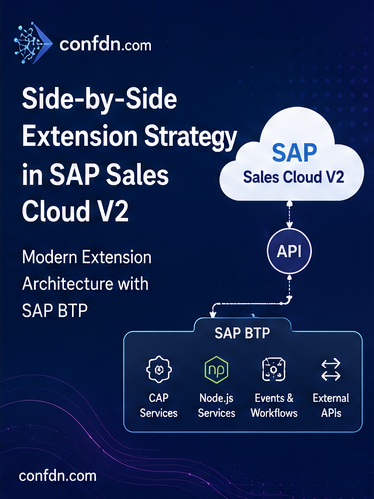
Side-by-Side Extension Strategy in SAP Sales Cloud V2
A technical guide to side-by-side extension architecture in SAP Sales Cloud V2 using SAP BTP, CAP, Node.js, and modern API-first approaches.
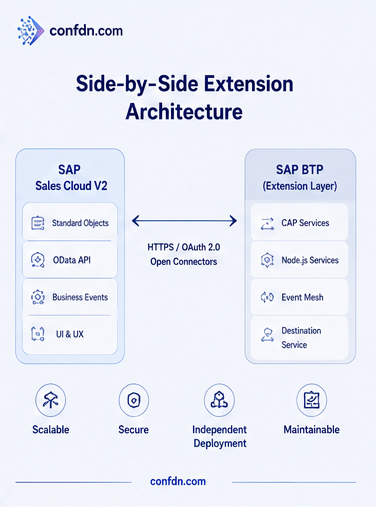
How Should Side-by-Side Extensions Be Built in SAP Sales Cloud V2?
With SAP Sales Cloud V2, the extension approach is evolving significantly.
Traditional embedded customizations are gradually being replaced by API-first and side-by-side architectures designed for modern cloud environments.
Modern enterprise applications now require scalable, loosely coupled, and independently deployable extension models — and this is where side-by-side architecture becomes critical.
Embedded Extension vs Side-by-Side Architecture
Embedded extensions provide fast customization capabilities directly inside the system.
However, they may become limited when it comes to:
❌ Scalability
❌ Independent deployments
❌ Complex processing
❌ External integrations
❌ Long-running operations
Side-by-side architecture, on the other hand, enables:
✔ Independent services
✔ Flexible deployment pipelines
✔ Cloud-native scalability
✔ External API integrations
✔ Modern backend architectures
This creates a much more sustainable and maintainable extension strategy.
Why SAP BTP Has Become Critical
In modern Sales Cloud V2 projects, processes such as:
- Long-running operations
- Asynchronous processing
- Advanced workflows
- External API orchestration
- Background jobs
- Complex integrations
are no longer ideal to implement directly inside the core application.
This is why SAP BTP-based side-by-side services are becoming increasingly important.
SAP BTP provides the flexibility to build modern extensions while keeping the core Sales Cloud environment clean and stable.
Real Project Scenarios
In real-world projects, side-by-side services can be extremely valuable for scenarios such as:
✔ Custom mail services
✔ Approval workflows
✔ External service integrations
✔ Event processing
✔ Background automation
✔ Advanced business logic
Node.js or CAP-based services running on SAP BTP can handle these operations more efficiently and independently.
This approach not only improves system stability but also simplifies maintenance and deployment processes.
The Biggest Mistake in Modern Extensions
One of the most common mistakes is trying to implement every business logic directly inside Sales Cloud.
This is not considered a modern extension strategy anymore.
Especially operations involving:
❌ Recursive processing
❌ Heavy computations
❌ External API calls
❌ Async workflows
❌ High-volume transactions
should be moved to side-by-side architectures whenever possible.
Keeping the core system lightweight is one of the key principles of scalable cloud architecture.
Why Side-by-Side Improves System Stability
Separating complex processes from the core application helps organizations achieve:
✔ Better scalability
✔ Easier maintenance
✔ Independent deployments
✔ Improved monitoring
✔ Safer upgrades
✔ Reduced system risk
This also allows development teams to adopt modern DevOps and CI/CD practices much more effectively.
Conclusion
With SAP Sales Cloud V2, modern extension strategies are clearly shifting toward side-by-side architecture.
SAP BTP is becoming the central platform for building scalable, maintainable, and cloud-native extensions.
Organizations that adopt API-first and side-by-side principles early will be much better prepared for future enterprise integration and extension requirements.
#SAP #SAPCX #SalesCloudV2 #ServiceCloudV2 #SAPBTP #SideBySide #CloudArchitecture #CAP #NodeJS #EnterpriseArchitecture #API #OData #SAPIntegrationSuite #DigitalTransformation