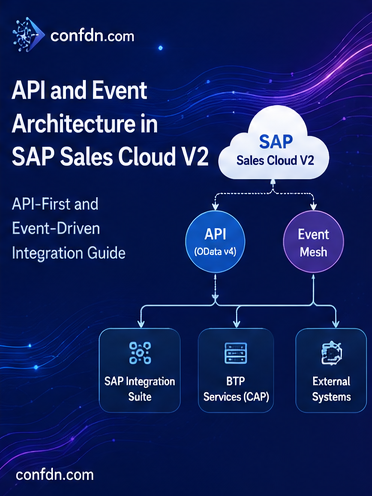
API and Event Architecture in SAP Sales Cloud V2
Understanding API-first and event-driven architecture in SAP Sales Cloud V2 with OData v4, Integration Suite, CAP, and modern integration patterns.
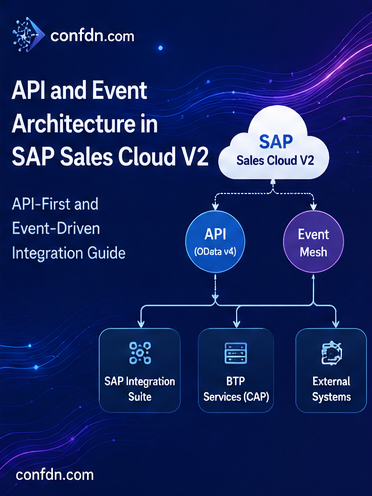
API and Event Architecture in SAP Sales Cloud V2
With SAP Sales Cloud V2, modern integration architecture has become more important than ever.
Today, organizations are moving away from traditional polling-based integrations and adopting API-first and event-driven approaches to build more scalable and real-time systems.
Sales Cloud V2 is designed to support modern enterprise integration scenarios with flexible APIs, event mechanisms, and cloud-native extension capabilities.
Why the API-First Approach Matters
SAP Sales Cloud V2 provides modern OData v4 APIs and flexible integration capabilities that simplify communication between systems.
This approach enables smoother integrations for:
✔ Frontend applications
✔ Mobile apps
✔ Middleware platforms
✔ External services
✔ Side-by-side extensions
As a result, integration architectures become more maintainable, scalable, and future-proof.
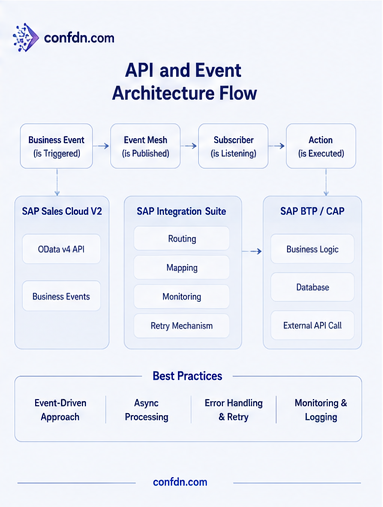
What is Event-Driven Architecture?
Event-driven architecture allows systems and services to react to events asynchronously.
For example:
- An Opportunity is updated
- A Ticket status changes
- A Workflow is triggered
- A new business object is created
These events can automatically notify other services and processes in real time.
This architecture enables:
✔ Asynchronous processing
✔ Queue-based workflows
✔ Loose coupling
✔ Real-time integrations
✔ Scalable system design
which are essential for modern cloud environments.
Why Polling Can Be Risky
Traditional polling approaches continuously check systems for updates at fixed intervals.
This can lead to:
❌ Unnecessary API traffic
❌ Performance bottlenecks
❌ Rate-limit issues
❌ Delayed processing
❌ Increased infrastructure costs
Event-driven systems, on the other hand, only trigger processes when required, making integrations far more efficient and scalable.
The Role of SAP Integration Suite and CAP
SAP Integration Suite plays a critical role in:
✔ Monitoring
✔ Retry management
✔ Orchestration
✔ Mapping
✔ Error handling
Especially in SAP and Non-SAP hybrid landscapes, centralized integration management becomes extremely valuable.
CAP (Cloud Application Programming Model) can be used to build modern side-by-side backend services for:
- Custom business logic
- Event processing
- API orchestration
- Microservice architectures
This provides a flexible foundation for cloud-native extensions on SAP BTP.
Error Handling and Retry Logic
In modern enterprise integrations, retry mechanisms and proper error handling are no longer optional.
Without monitoring and recovery strategies, integrations may cause:
❌ Silent data loss
❌ Synchronization issues
❌ Duplicate records
❌ Failed transactions
This is why modern architectures heavily rely on:
✔ Retry logic
✔ Dead-letter queues
✔ Monitoring tools
✔ Alert mechanisms
✔ Centralized logging
to ensure production stability.
Conclusion
Modern integration architecture in SAP Sales Cloud V2 is no longer just about consuming APIs.
With API-first and event-driven design principles, organizations can build more scalable, maintainable, and real-time enterprise systems.
When combined with SAP Integration Suite, CAP, and modern event processing approaches, Sales Cloud V2 becomes a powerful platform for next-generation enterprise integrations.
#SAP #SAPCX #SalesCloudV2 #ServiceCloudV2 #SAPBTP #IntegrationSuite #CAP #EventDrivenArchitecture #API #OData #CloudArchitecture #EnterpriseIntegration