How Communication Should Be Designed Between SAP C4C and SAP / Non-SAP Systems
Best practices for SAP C4C integrations with SAP and non-SAP systems, including Communication Arrangement design, middleware usage, and common integration mistakes.
How Communication Should Be Designed Between SAP C4C and SAP / Non-SAP Systems
One of the most critical aspects of SAP C4C projects is integration architecture.
Many implementations may appear technically successful at the beginning, but poorly designed communication structures often lead to:
- Performance bottlenecks
- Data inconsistencies
- Monitoring difficulties
- Scalability limitations
- High maintenance costs
- Long-term operational instability
In enterprise environments, integration design is often more important than the actual code itself.
Communication Architecture in SAP C4C
External communication in SAP C4C is typically managed through:
- Communication Systems
- Communication Arrangements
- Communication Scenarios
- OData Services
- SOAP Services
These components are designed to provide:
- Secure connectivity
- Authentication management
- Standardized data exchange
- Monitoring capabilities
- Controlled integration governance
- Reliable system-to-system communication
A properly designed communication layer significantly increases system stability and maintainability.
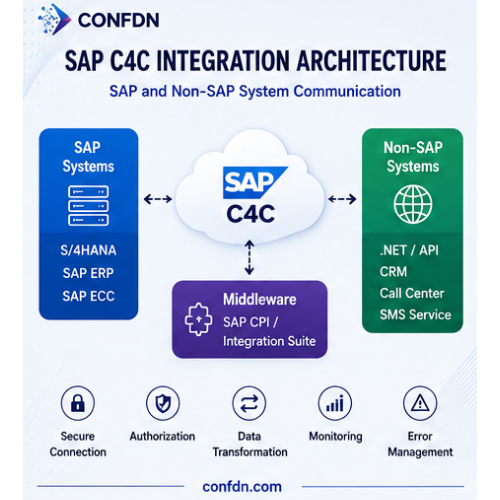
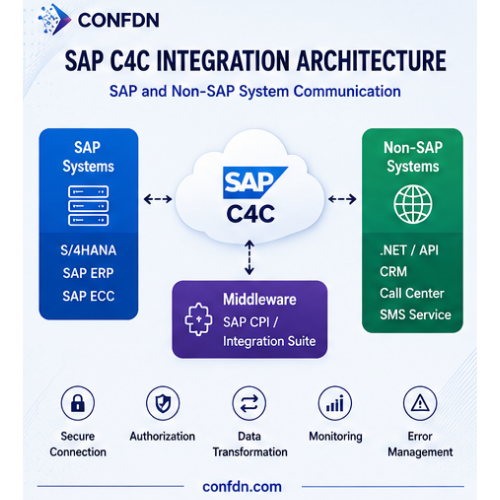
Communication with SAP Systems
For integrations with SAP ERP or SAP S/4HANA systems, using middleware is strongly recommended.
Solutions such as:
- SAP CPI
- SAP Integration Suite
provide major advantages including:
- Centralized monitoring
- Retry mechanisms
- Payload transformation and mapping
- Error handling
- Message orchestration
- Queue-based processing
One of the most common architectural mistakes is connecting SAP C4C directly to ERP systems without an integration layer.
Although this approach may seem faster initially, it usually becomes difficult to manage as the system landscape grows.
Direct integrations often create:
- Tight coupling between systems
- Complex error handling
- Limited monitoring visibility
- Higher maintenance effort
- Increased operational risks
Communication with Non-SAP Systems
In Non-SAP integrations, payload stability becomes critically important.
This is especially true when integrating SAP C4C with:
- .NET APIs
- Node.js services
- CRM platforms
- Third-party applications
- Custom microservice architectures
One of the most common problems in these projects is the continuous modification of:
- Field names
- Request structures
- Response models
- Authentication methods
Even small payload changes can easily break existing integrations if versioning and governance are not properly managed.
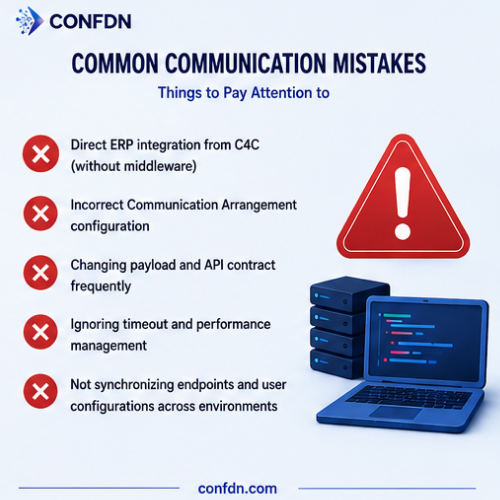
Most Common Integration Mistakes
Common architectural issues in SAP C4C projects include:
- Direct ERP integration without middleware
- Incorrect Communication Arrangement design
- Frequently changing payload structures
- Ignoring monitoring processes
- Missing timeout management
- Lack of retry mechanisms
- Poor error logging strategies
- Building tightly coupled integrations
These problems may not appear immediately, but they often become major operational issues over time.
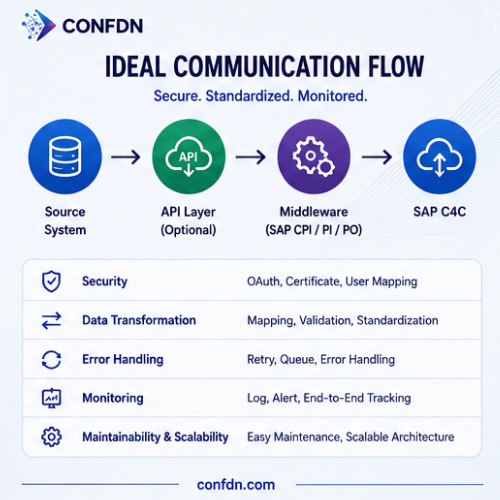
Recommended Architecture
In enterprise-level implementations, the most sustainable approach is usually:
SAP Landscape
SAP → Middleware → C4C
Non-SAP Landscape
Non-SAP → API Layer → Middleware → C4C
This architecture provides:
- Loosely coupled systems
- Centralized monitoring
- Better scalability
- Easier payload transformation
- More reliable error handling
- Improved maintainability
- Faster onboarding of new integrations
Best Practice Recommendations
- Avoid direct system-to-system integrations
- Use middleware whenever possible
- Keep payload contracts stable
- Implement API versioning strategies
- Design proper timeout and retry policies
- Establish centralized monitoring and alerting
- Maintain detailed integration logging
- Build integration governance standards
Conclusion
In SAP C4C integration projects, failures are usually not caused by code itself, but by poor communication architecture.
A successful integration landscape requires more than simply making services work — it must also be scalable, maintainable, monitorable, and resilient.
Well-designed communication architecture directly impacts both system stability and long-term project sustainability.