Do You Really Need SAP Commerce? Understanding the Difference Between On-Premise and Cloud
Is SAP Commerce the right choice for your business? Discover when it makes sense to invest in SAP Commerce and understand the key differences between On-Premise and Cloud through real business scenarios.
Do You Really Need SAP Commerce?
You Don't Realize It When the Project Starts — You Realize It When Your Business Begins to Grow
The first meetings of an e-commerce project usually sound very similar. The goal is simple: sell products online, accept orders, integrate a payment system, and give customers a smooth shopping experience. Everyone around the table is focused on launching the project as quickly as possible.
At this stage, very few people think about the future—and honestly, there seems to be no reason to.
There are only a few hundred products. The business operates in a single country. One price list is enough, and the number of daily orders is manageable. Most e-commerce platforms on the market can easily handle these requirements, so no one asks a bigger question:
"Do we really need an enterprise commerce platform?"
A few months pass.
The company starts expanding into new markets. Distributors, partners, and end customers all need to use the same platform. The marketing team wants to run different campaigns for different countries. Inventory in the ERP system must be reflected on the website in real time. Customer service expects to manage orders from a single interface. Different customer groups require different pricing models.
That's when the team realizes something important.
They are no longer managing an online store.
They are managing an entire commerce operation.
This is exactly where SAP Commerce begins to show its value. It is much more than a storefront for displaying products. It brings together product catalogs, pricing, customer segmentation, order management, and ERP integrations within a single platform. Whether customers shop through a website, a mobile application, a call center, or another sales channel, everything can operate on the same commerce foundation. As the business grows, the platform grows with it instead of forcing the company to rebuild its infrastructure.
At first glance, this may sound like a challenge only large enterprises face. In reality, it is one of the most common turning points in digital transformation projects. Decisions made to satisfy today's requirements often become tomorrow's biggest limitations.
Soon, another question appears during project meetings.
"Where should we run this platform?"
At first, it feels like a question only the IT department needs to answer.
Over time, however, it becomes clear that this decision shapes the way the entire organization works.
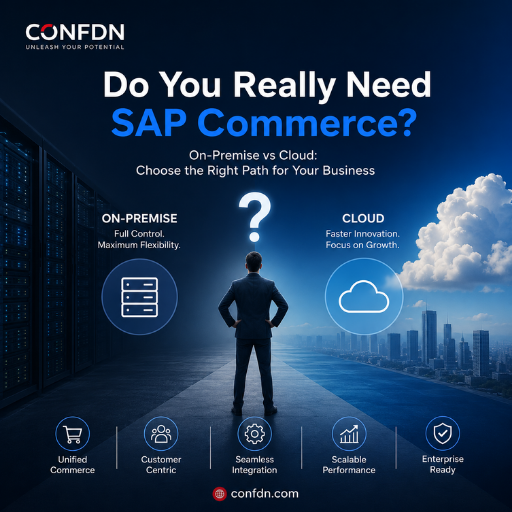
Some companies want complete control over their infrastructure. They prefer knowing exactly where their servers are running, defining their own security policies, managing maintenance schedules internally, and customizing the platform whenever necessary. In industries such as banking, healthcare, government, or defense, this approach is often driven by regulations rather than preference.
SAP Commerce On-Premise is designed for organizations with these requirements. The platform runs inside the company's own data center or in a cloud environment fully managed by its IT team. This provides a high level of flexibility and control over the infrastructure. At the same time, it also means the organization is responsible for system administration, security updates, performance monitoring, capacity planning, backups, and ongoing maintenance.
Now imagine another company approaching the very same project differently.
Instead of discussing servers, the conversations revolve around customers. How quickly can the business enter a new market? How easily can marketing teams launch campaigns? Will the platform handle peak traffic during Black Friday without compromising the customer experience?
No one talks about storage capacity or operating system updates.
That's because they're using SAP Commerce Cloud.
With the Cloud edition, SAP manages the underlying platform and many operational responsibilities. As a result, development teams spend less time maintaining infrastructure and more time improving customer experiences, building integrations, and delivering new business capabilities.
Of course, this approach also comes with trade-offs. Organizations don't have the same level of infrastructure control available in an On-Premise environment. Direct server access is limited, and certain platform configurations follow SAP's operational standards.
Yet both companies are using the same product.
Both sell products through SAP Commerce.
Both process orders.
Both integrate with their ERP systems.
The difference lies in where their teams invest their time. One organization focuses heavily on infrastructure management, while the other dedicates more resources to innovation and customer experience. Choosing between On-Premise and Cloud is therefore not simply a technical decision. It is a strategic choice that reflects the company's culture, IT capabilities, compliance requirements, and long-term business goals.
So, is SAP Commerce the right solution for every business?
Not necessarily.
If your company operates in a single market, manages only a few hundred products, and has limited integration requirements, SAP Commerce may be more than you actually need. In many cases, a lighter e-commerce platform can deliver everything required with lower cost and complexity.
However, if your product catalog continues to grow, your business operates across multiple countries, you need to support both B2B and B2C commerce, your ERP system sits at the center of your operations, and digital commerce has become one of your company's primary growth drivers, then your challenge is no longer building an online store.
You're building a digital commerce ecosystem.
At that point, the question is no longer:
"Should we use SAP Commerce?"
Instead, it becomes something far more important:
Can our current platform support the business we'll become three years from now?