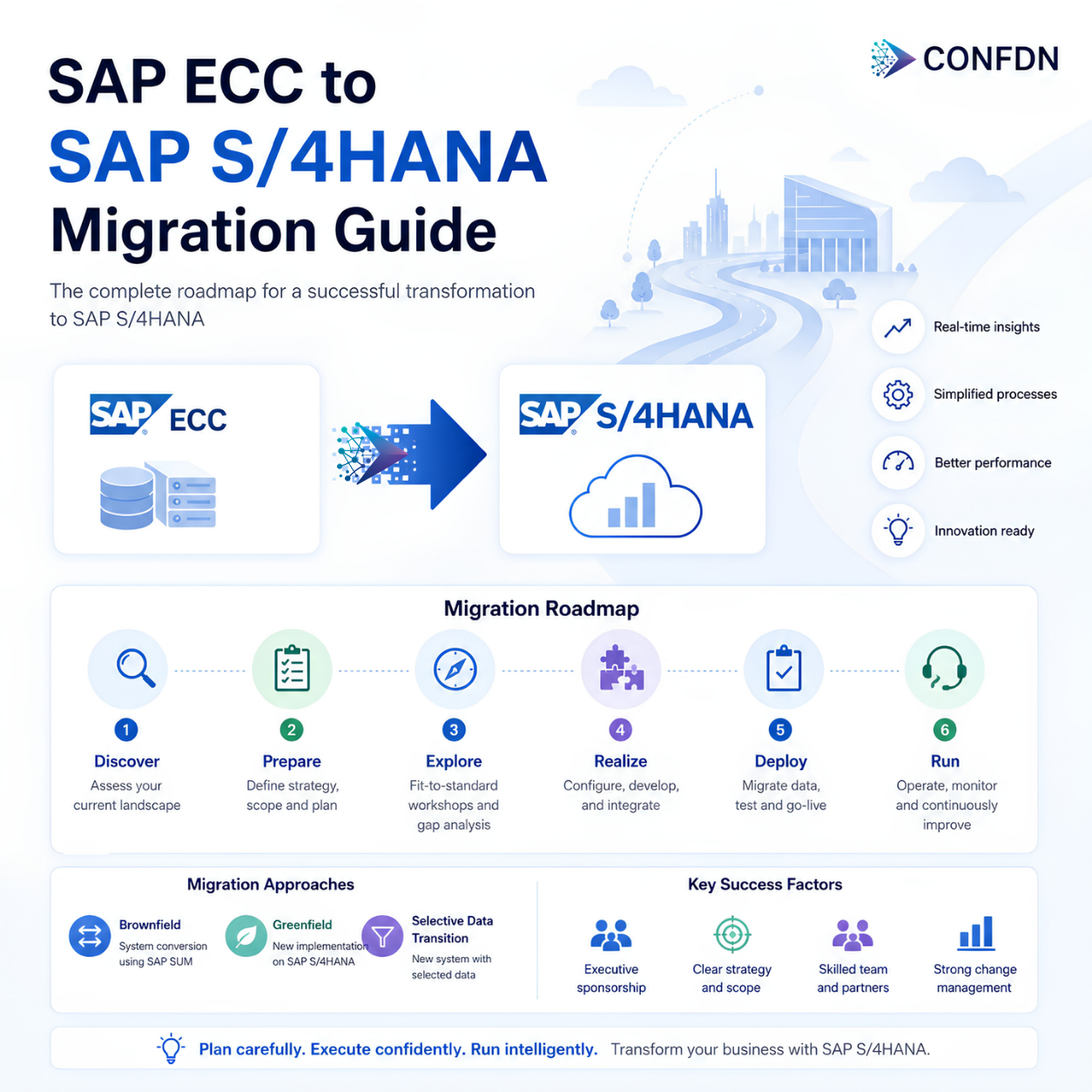
SAP ECC to SAP S/4HANA Migration Guide: Complete Strategy, Assessment and Best Practices
Learn the complete SAP ECC to SAP S/4HANA migration strategy, readiness assessment, migration approaches, and best practices for a successful transformation.
A Practical, Human-Centric Guide to Migrating from SAP ECC to SAP S/4HANA
For many SAP customers, moving from ECC to S/4HANA is no longer a “nice-to-have” future project. It has become a strategic necessity. SAP’s support timeline is one reason, but the real driver is this: S/4HANA changes how companies operate. It brings speed, real-time visibility, simplified data structures, and a modern user experience.
But let’s be honest.
This transformation isn’t simple.
It’s not just a technical upgrade.
And if it’s not planned well, it can become expensive, slow, and painful.
This guide aims to cut through the noise and explain the S/4HANA journey in a realistic, human way:
What you need to analyze, which migration approach fits your organization, where projects usually struggle, and what successful companies do differently.
1. Migration Assessment: The Real Starting Point
Every S/4HANA project begins long before any system is installed.
It starts with understanding what you have today.
1.1 Custom Code (Z-Objects)
ECC systems often carry years of technical debt — unused reports, outdated enhancements, forgotten batch jobs.
Key questions:
- Is this custom code still used?
- Does it rely on tables or functions removed in S/4HANA?
- Will it perform well on HANA’s in-memory architecture?
- Should it be redesigned, optimized, or retired?
Useful SAP tools:
- SAP Readiness Check
- ABAP Test Cockpit (ATC)
- Custom Code Migration App
Reference: SAP Note 2913617 – Custom Code Migration Guide
1.2 Integrations
S/4HANA is built for API-driven communication.
This means older IDoc/RFC-heavy integrations need a fresh look.
What to review:
- PI/PO or CPI integration compatibility
- IDoc versions and replacements
- API Business Hub for new REST/OData APIs
- Cloud integration requirements
Reference: SAP API Business Hub – api.sap.com
1.3 Data Quality
Data is one of the biggest reasons S/4HANA projects slow down.
ECC systems often contain:
- Duplicate master data
- Incomplete or inconsistent records
- Years of historical documents
- Data that should have been archived long ago
Gartner reports show that 40% of ERP transformation delays are caused by poor data quality.
1.4 Business Processes
S/4HANA is not a copy of ECC.
It simplifies processes, especially in Finance with the Universal Journal.
You should evaluate:
- Current processes
- SAP Best Practice processes
- Manual steps that can be automated
- Redundant process variants
Reference: SAP Best Practices Explorer – rapid.sap.com/bp/
2. Migration Approaches: Greenfield, Brownfield, Bluefield
There is no single “best” approach.
The right choice depends on your company’s history, complexity, and goals.
2.1 Greenfield – Starting Fresh
Think of this as building a new house instead of renovating the old one.
Best for companies that:
- Want to simplify and standardize
- Have outdated or overly customized processes
- Need a clean data foundation
- Operate across multiple countries and want harmonization
Pros
- Clean, modern, standardized processes
- Fiori-first user experience
- No technical debt carried over
Cons
- High change management effort
- Longer user adaptation
- Typically longer project duration
2.2 Brownfield – Converting the Existing System
This is like renovating your current house without tearing it down.
Best for companies that:
- Have stable, well-functioning ECC processes
- Want a faster transition
- Prefer minimal business disruption
Pros
- Faster
- Lower cost
- Minimal process change
Cons
- Some old complexity may remain
- Data quality issues may persist
2.3 Bluefield – Selective Transformation
A hybrid approach: keep what works, redesign what doesn’t.
Best for companies that:
- Want selective data migration
- Need to harmonize processes across entities
- Want flexibility without starting from scratch
Pros
- Balanced approach
- Controlled transformation
- Ability to choose which data and processes move forward
Cons
- Requires specialized tools
- Higher partner dependency
References:
SNP, Natuvion, Datavard Selective Data Transition Whitepapers
3. Best Practices: What Successful Projects Have in Common
3.1 Start Analysis Early
The earlier you run Readiness Check, Process Discovery, and custom code analysis, the fewer surprises you’ll face.
3.2 Clean Up Custom Code
Most companies reduce unused Z-objects by 30–60% before migration.
3.3 Clean Your Data
S/4HANA rewards clean data with better performance and better reporting.
3.4 Build a Strong Test Strategy
Critical test phases include:
- Integration testing
- User acceptance testing
- Cutover rehearsals
- Performance testing
3.5 Involve Business Teams Early
S/4HANA is not an IT project.
It’s a business transformation.
3.6 Invest in Change Management
Training, communication, and user adoption are as important as the technical work.
4. Cutover and Go-Live: The Most Sensitive Phase
A strong cutover plan includes:
- Freeze periods
- Data migration steps
- System downtime windows
- Rollback scenarios
- Hypercare support
Reference: SAP Activate – Deploy Phase
Migrating to S/4HANA is not just about technology.
It’s about preparing your company for the next decade of digital operations.
With the right analysis, the right approach, and the right team, the journey becomes far smoother — and the benefits far greater.