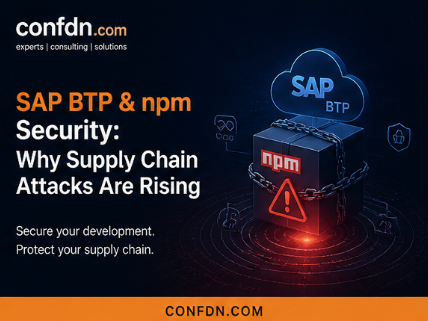
SAP BTP and npm Security: Why Supply Chain Attacks Are Rising
The compromise of SAP-related npm packages highlights the growing risk of software supply chain attacks. What it means for SAP BTP developers and how to stay secure.
SAP BTP and npm Security: Why Supply Chain Attacks Are Rising
The recent compromise of SAP-related npm packages once again highlights how critical supply chain attacks have become in modern software development.
Full article:
https://thehackernews.com/2026/04/sap-npm-packages-compromised-by-mini.html
As npm usage rapidly increases within SAP Business Technology Platform (BTP) projects, these attacks are no longer theoretical — they directly impact development teams.
If you want to better understand npm security and integration risks in SAP BTP environments, you can explore our SAP BTP consulting services:
https://confdn.com/en/services/sap-btp-consulting
🔎 What Happened?
The attack mechanism is both simple and dangerous:
- Malicious code is executed via preinstall scripts in npm packages
- Tokens, API keys, and secrets are collected from developer environments
- The attack spreads through CI/CD pipelines and repositories
- AI-powered development tools can unintentionally accelerate this spread
⚠️ Why This Matters
Modern development heavily relies on:
- Open-source npm packages
- CI/CD pipelines
- AI-assisted coding tools
These tools increase development speed — but also expand the attack surface.
Attackers no longer need to target your application directly.
Compromising a dependency is often enough.
In many SAP projects, security is treated as a late-stage concern. However, this approach creates serious risks in modern cloud architectures. For a broader perspective, you can read:
https://confdn.com/en/blog/why-sap-projects-fail
🛡️ What Should SAP BTP Developers Do?
The key here is a proactive security approach.
✔ Dependency management
- Lock dependencies using lockfiles
- Avoid uncontrolled version updates
✔ Script awareness
- Review preinstall and postinstall scripts carefully
- Minimize automatic script execution
✔ Secret management
- Never store tokens or API keys in code
- Use environment variables and secret managers
✔ CI/CD security
- Apply least privilege principles
- Restrict pipeline tokens
✔ Monitoring and logs
- Regularly review repository and access logs
- Detect suspicious activities early
✔ AI tooling awareness
- Limit access scopes for AI tools
- Always review generated code from a security perspective
These practices not only improve security but also help you build a more sustainable and manageable SAP BTP architecture.
🧠 Final Thought
AI and modern development tools provide incredible speed. However, this speed comes with hidden risks.
With the increasing use of npm in SAP BTP environments, security is no longer just an IT or security team responsibility — it is now part of the development lifecycle.
If you want to assess your current setup, identify risks, and build a secure architecture, you can explore our SAP BTP consulting approach or evaluate your system together with us:
https://confdn.com/en/services/sap-btp-consulting
Is your SAP BTP environment truly secure — or just running?